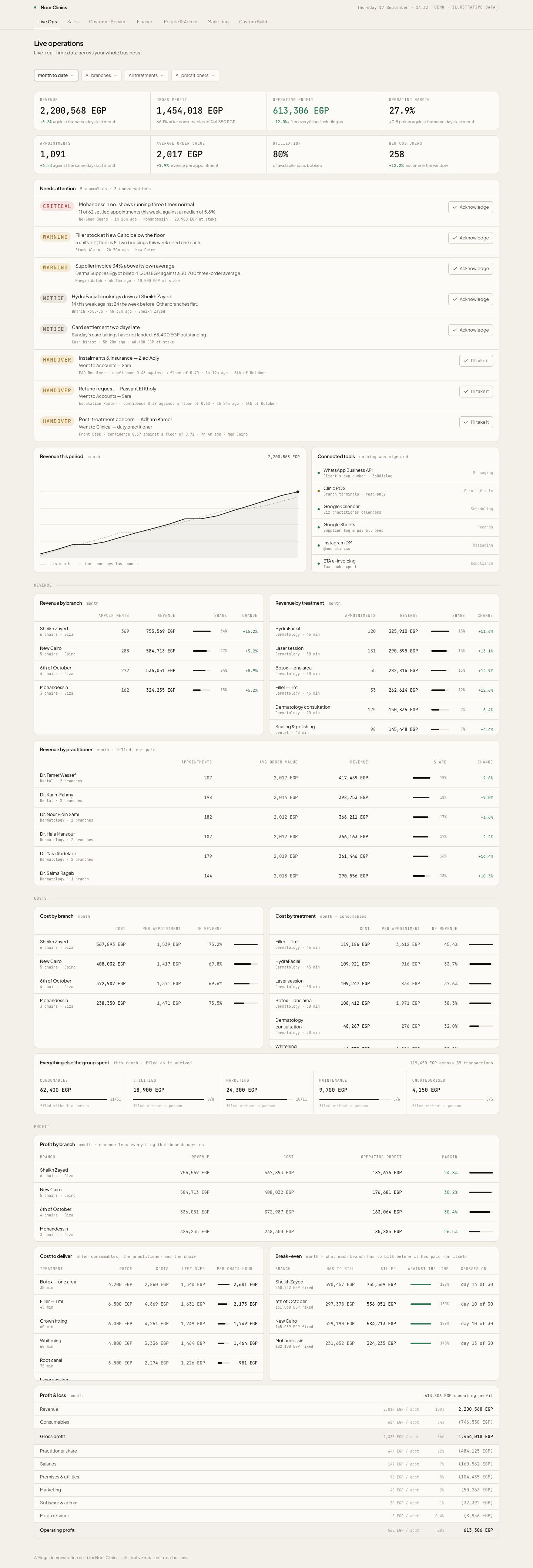
01 Live Ops
Revenue, profit and every problem in the business — live, on one screen
Portfolio — Omar Gaafar
I build the agent systems, workflow automation and operations dashboards a business actually runs on.
01 — What I build
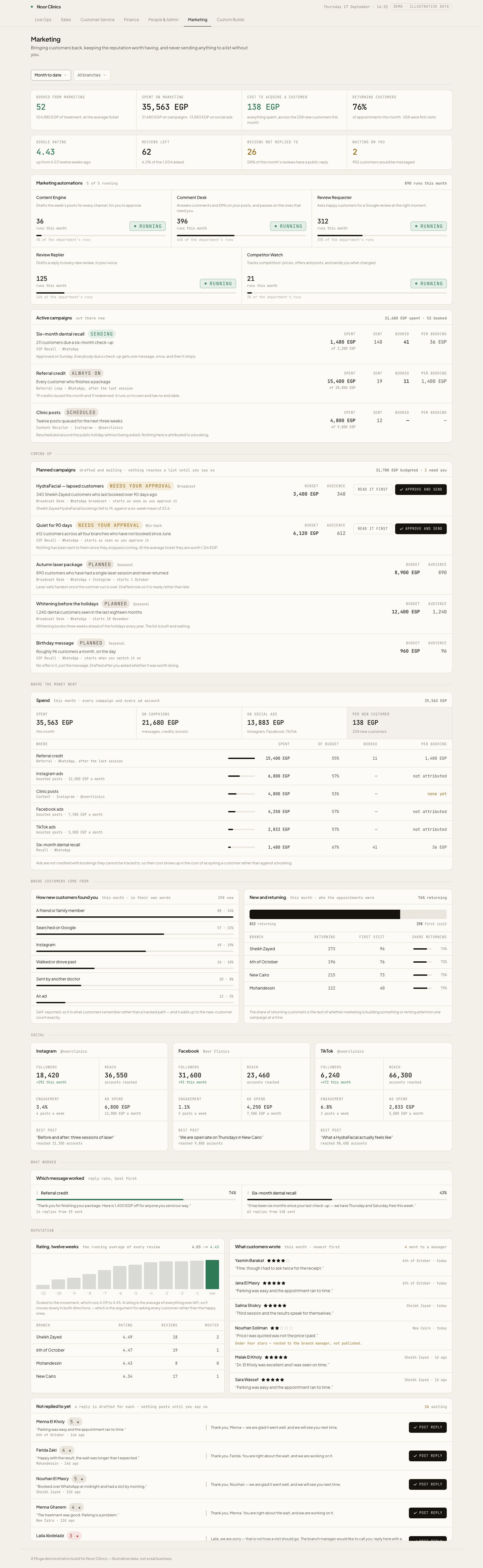
01 Live Ops
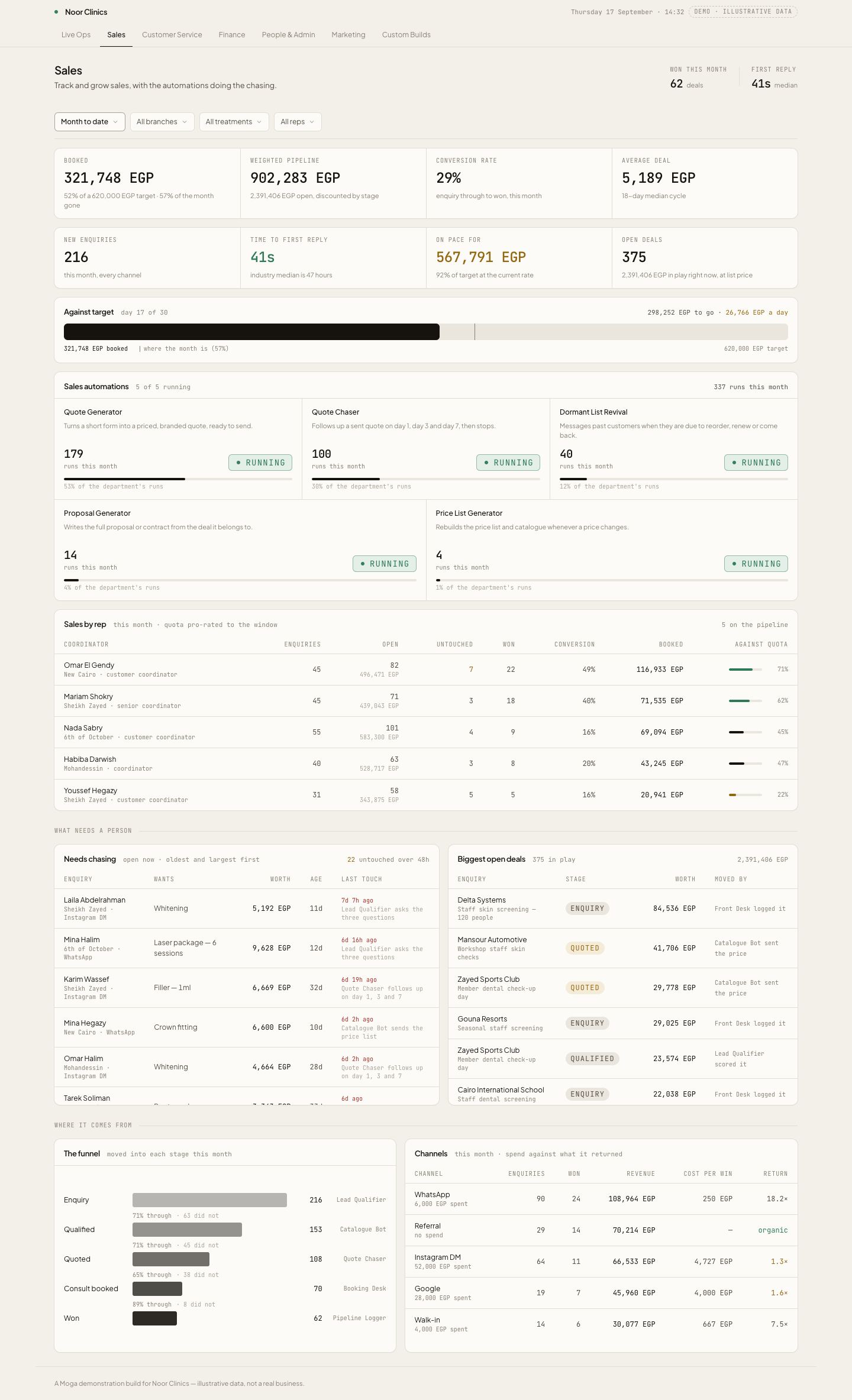
02 Sales
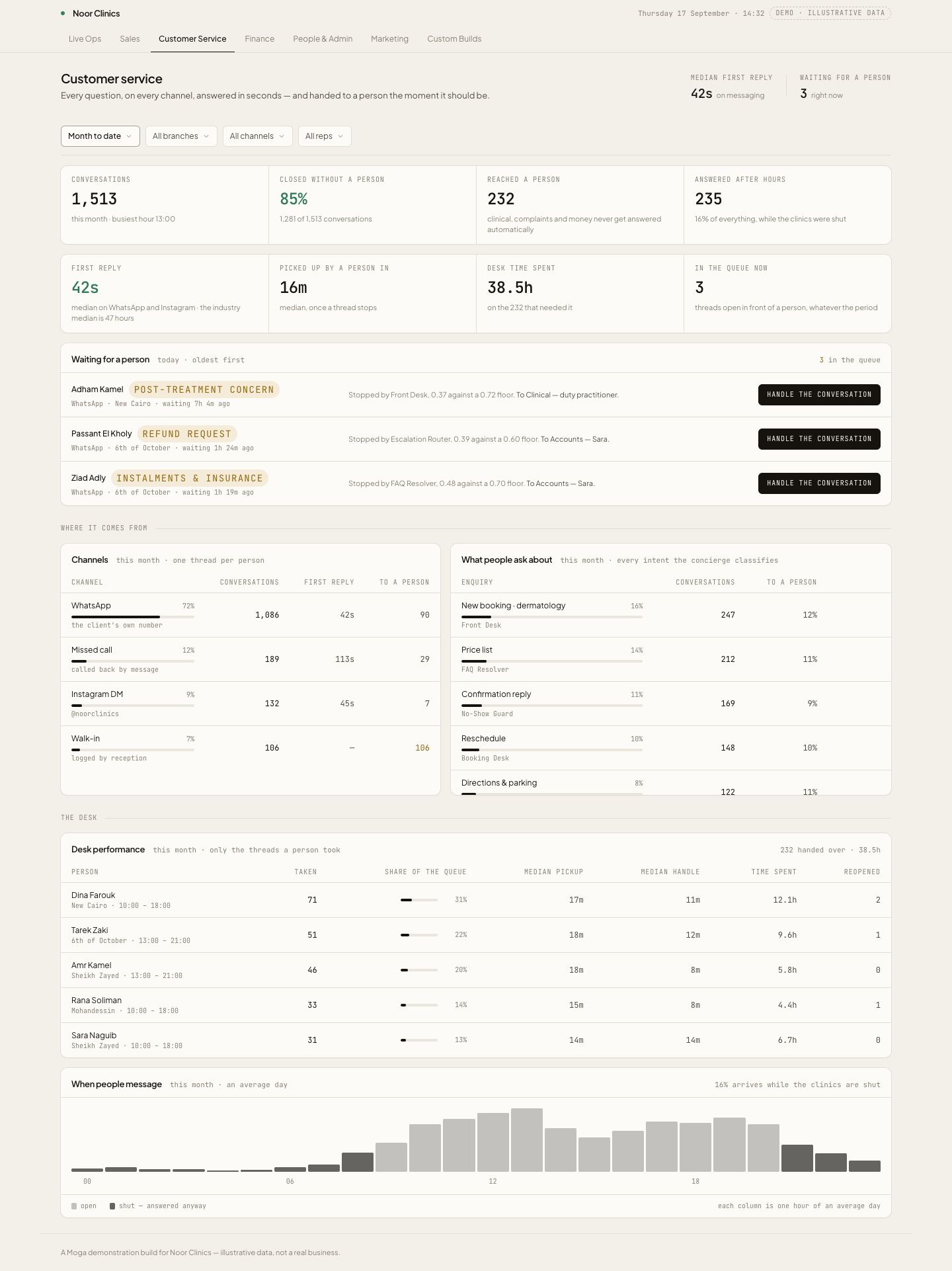
03 Customer Service
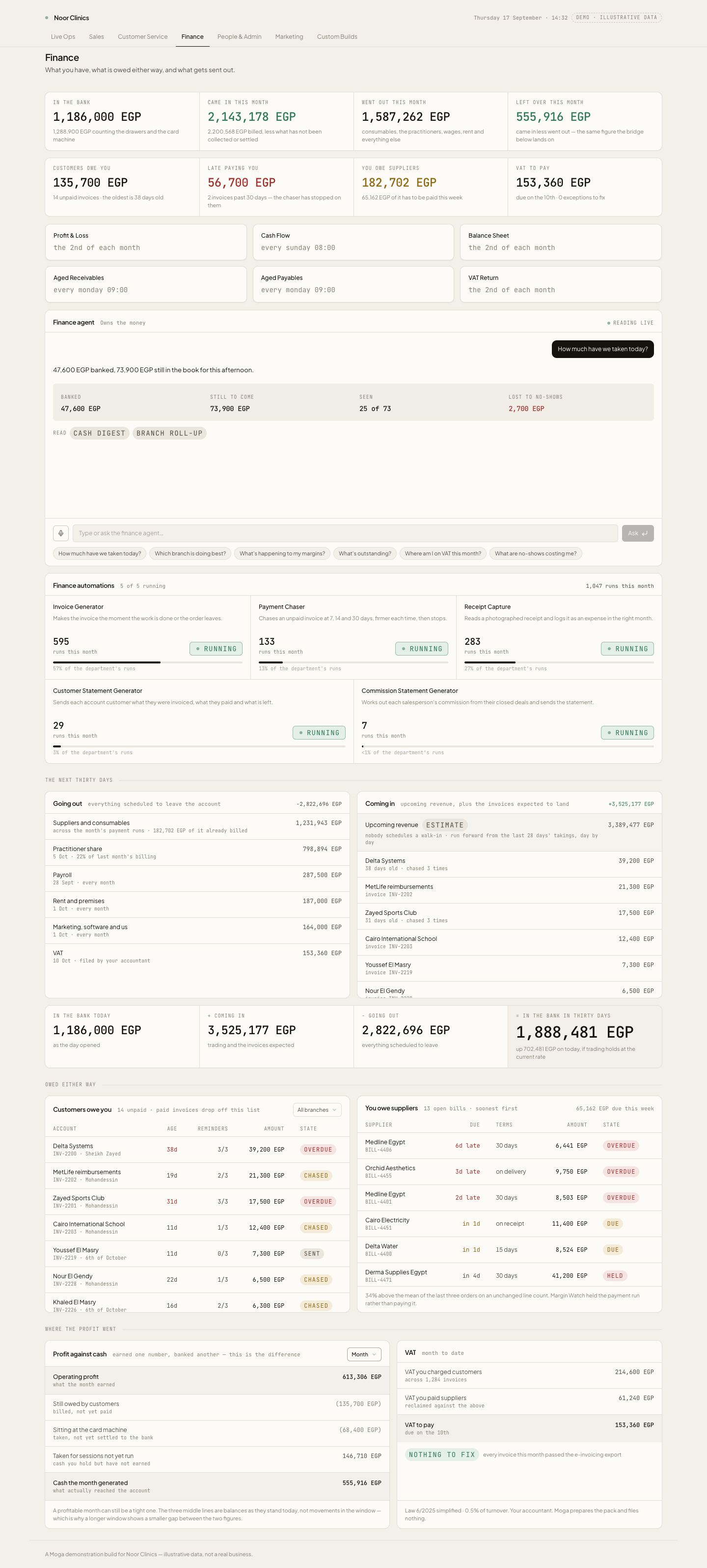
04 Finance
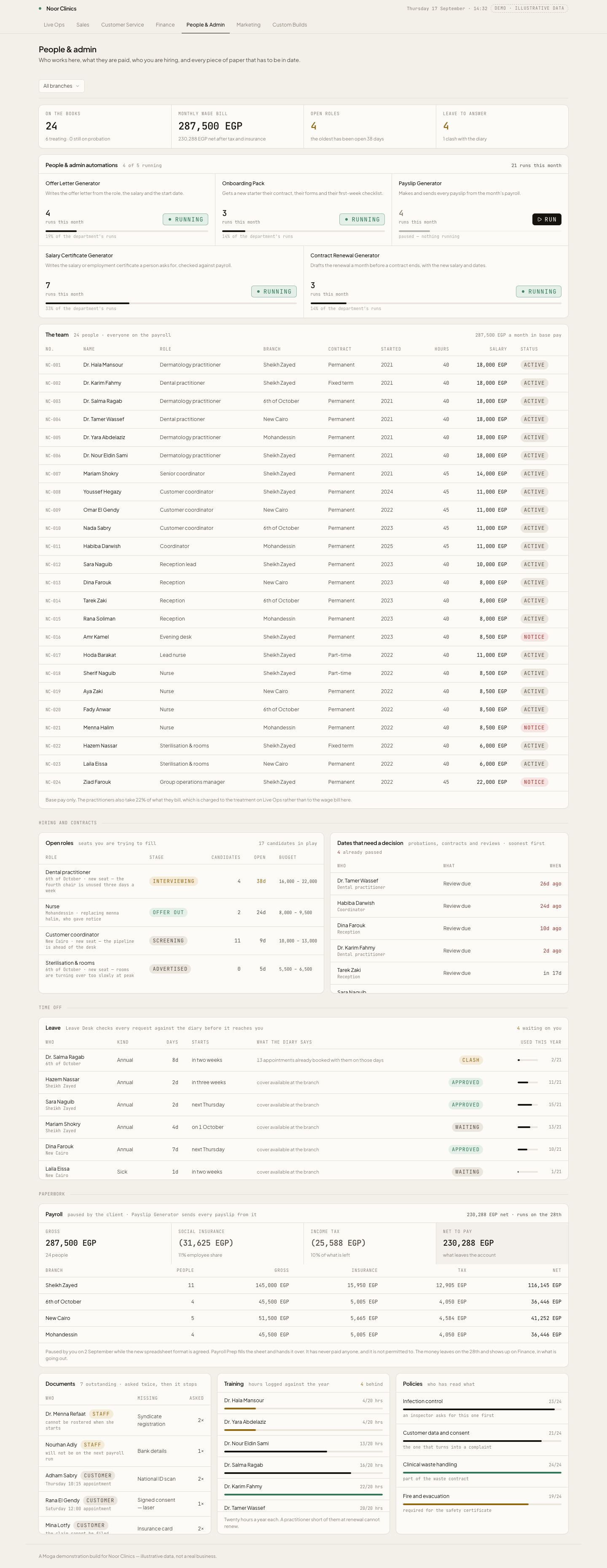
05 People & Admin
06 Marketing
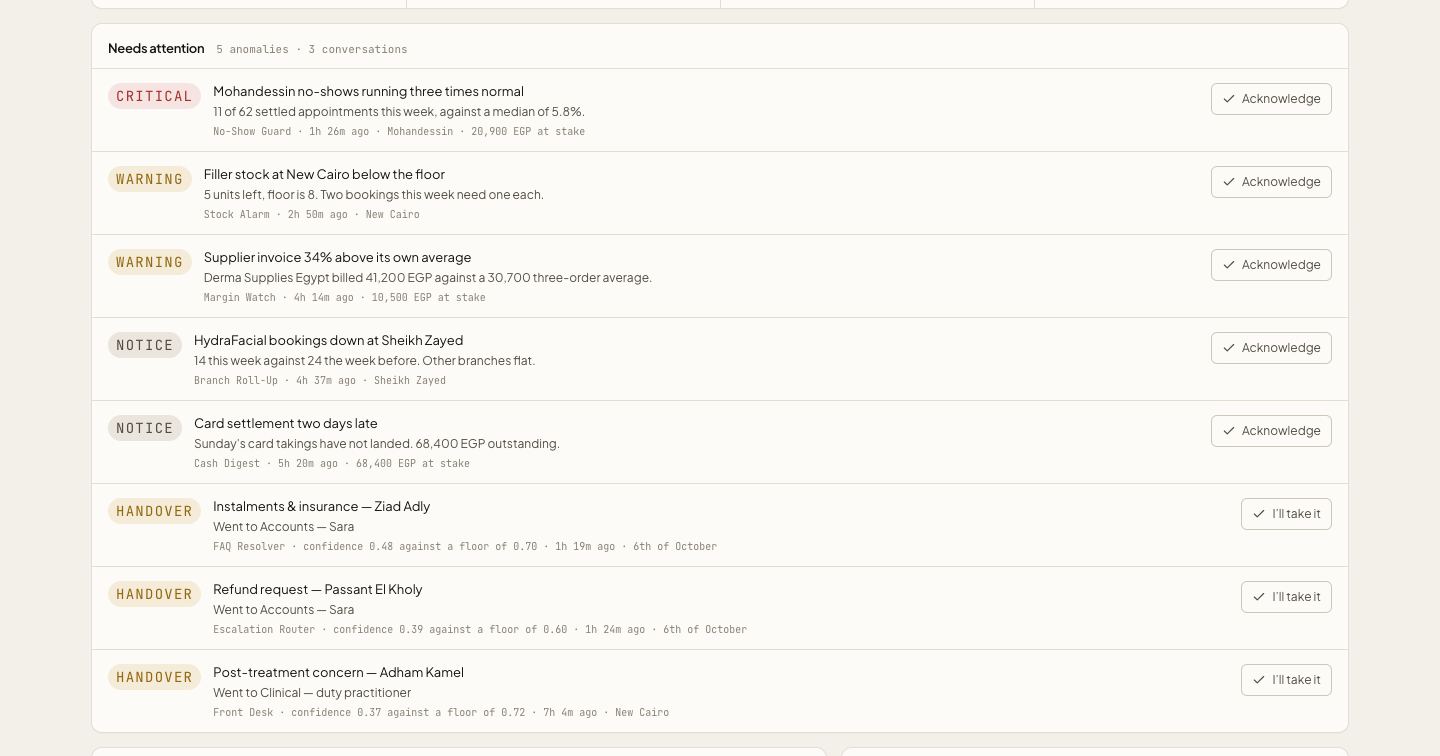
07 Anomaly Detection
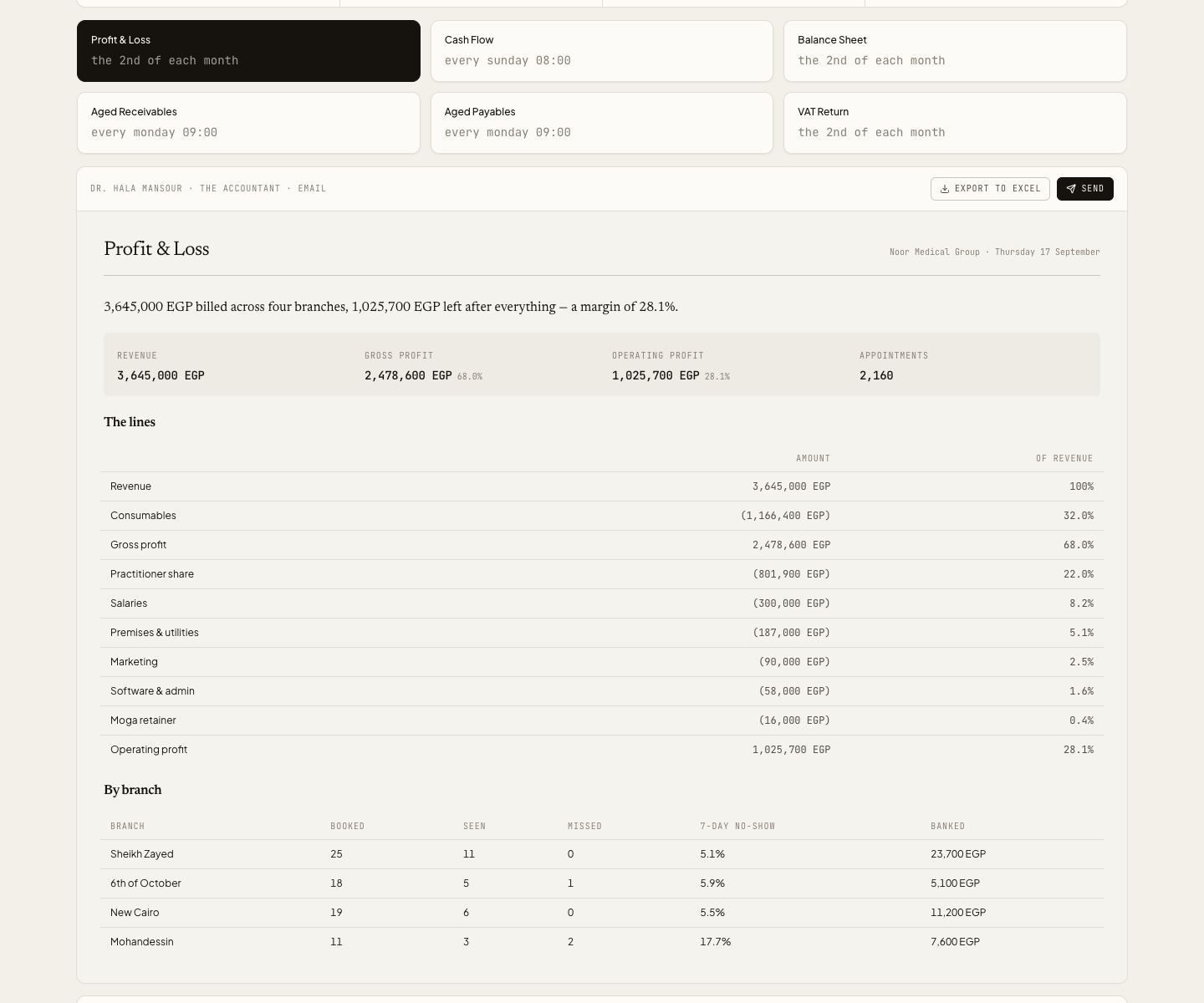
08 One-Click Reports
The real platform, running on sample data — not a client deployment.
02 — Agent systems
01 / 08
I run a twenty-agent system daily and built every part of it. These are the capabilities that separate an agent that can act on a business from a chat window with a good prompt.
Independent work runs at the same time instead of queueing — several agents on different parts of a problem at once, each in its own context, reporting back to be reconciled.
Why it matters — the difference between an answer in two minutes and one in twenty.
Any agent can hand work to any other, so the chain forms around the problem rather than being fixed in advance — with rules that stop a delegation loop before it starts.
Why it matters — a rigid org chart makes the system slower than the person it replaced.
Packaged procedures an agent loads only when the task calls for them, so expertise is available without sitting in memory permanently. I author them, and I built the skill that writes new ones.
Why it matters — a process stops depending on whoever remembers how it goes.
Model Context Protocol servers give an agent typed, permitted access to what a business actually runs on: the database, the document store, version control, the file system.
Why it matters — an agent that can't touch your systems can only ever give advice.
Decisions and prior work persist between sessions in a searchable local store, so the system starts knowing what was settled last week instead of starting from nothing.
Why it matters — re-explaining the business every morning is why most agent pilots quietly die.
Ordinary code running before and after every action, outside the model's control: blocks destructive commands, keeps credentials and personal data out of anything that leaves the machine.
Why it matters — safety you can only ask for politely isn't safety.
Mechanical work runs on the cheapest capable model; only ambiguous or irreversible decisions escalate. The routing table is a real design document, not a default.
Why it matters — this one decision is what makes a system this size affordable to run.
Each role gets only the tools its job needs, and every result is treated as a claim to be checked — a number without the query that produced it doesn't get used.
Why it matters — a confident wrong answer costs more than no answer.
03 — Value
Hours back
Intake, routing, chasing, scheduling and reporting are rules dressed up as jobs. Once they run themselves, the people who were doing them go back to the parts that actually need a person.
From — sales, HR and approval automation
More output, same headcount
Several agents working different parts of a problem at once, on a chain chosen by the task, means the throughput of a small team without the coordination cost of a large one.
From — the agent layer
Money kept
Every branch compared against its own history and its peers, ranked by severity. The outlier surfaces itself instead of waiting to be noticed in a quarterly review, which is usually one quarter too late.
From — anomaly and loss detection
Faster, more informed decisions
When the numbers are already on screen and any question can be asked in plain language, the delay between wanting to know something and knowing it stops being measured in days.
From — live operations and the finance assistant
Nothing dropped
Severity ordering, breach detection and dual confirmation mean the question "did that ever actually get done?" has an answer that doesn't require asking anyone.
From — approval and request workflows
Always open
Enquiries captured and answered from the business's own material across every channel, day and night, with a clean handover the moment a person is genuinely needed.
From — the support chatbot and sales automation
04 — Stack
05 — Track
06 — Contact